
What Is Wi-Fi HaLow? A Complete Guide to Vantron’s Next-Gen IoT Wireless Solutions
2026/08/05
Many factories, warehouses, and logistics hubs often need wireless coverage beyond a room or production cell. Conventional Wi-Fi can require extra access points, cabling, and power infrastructure, yet it delivers a limited connectivity radius with poor obstacle penetration. Wi-Fi HaLow closes this gap by operating in the sub-1 GHz band, delivering better obstacle penetration, kilometer-scale communication, support for thousands of connected devices, and years-long battery life. For enterprises planning connected products or facilities, Vantron combines this technology with integrated embedded, edge, networking, and cloud capabilities to deliver seamless, scalable, and secure industrial IoT solutions.
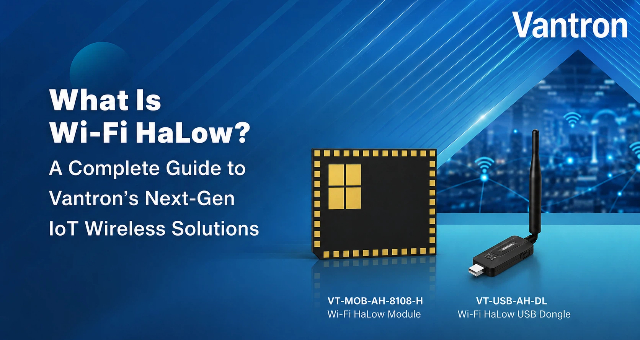
What Is Wi-Fi HaLow?
Wi-Fi HaLow is a low-power, long-range extension of traditional Wi-Fi based on the IEEE 802.11ah standard. Unlike traditional Wi-Fi networks that operate on the 2.4 GHz, 5 GHz, or 6 GHz bands, Wi-Fi HaLow operates in the sub-1 GHz license-free radio spectrum (typically 850 MHz to 950 MHz, depending on regional regulations).
By utilizing lower frequency radio waves, this technology successfully bridges the gap between high-bandwidth, short-range local area networks (LAN) and low-bandwidth, long-range wide area networks (LPWAN). It offers the familiar, native IP-based architecture of traditional Wi-Fi but with significantly extended reach, robust obstacle penetration, and optimized power efficiency tailored specifically for the IoT.
Why Traditional Wireless Networks Fall Short for Industrial IoT?
Traditional Wi-Fi remains the right choice for indoor networks within well-covered areas. The following challenge appears when an enterprise tries to reuse the same network architecture for thousands of low-duty-cycle devices spread across a factory, warehouse, utility site, rail depot, or outdoor yard.
1.Limited Range and Penetration
High-frequency 2.4 GHz and 5 GHz signals degrade quickly over distance and struggle to penetrate dense industrial materials. In a smart warehouse environment with heavy metal racking, or in a smart energy deployment with basement-level utility meters, traditional Wi-Fi signals suffer from severe attenuation, leading to dead zones and dropped packets.
2.High Power Consumption
Standard Wi-Fi protocols are designed for high-throughput devices with constant power supplies, like laptops or smartphones. They require endpoints to wake frequently from power-saving modes to maintain network connections. For battery-operated medical devices or remote environmental sensors, this continuous power draw rapidly drains batteries, driving up maintenance costs.
3.Poor Scalability
A standard enterprise access point (AP) typically maxes out at a few hundred concurrent device connections. In large-scale deployments, such as a factory floor with thousands of connected sensors, actuators, and AMR (Autonomous Mobile Robot) units, standard APs quickly become overwhelmed, leading to network congestion and latency.
4.High Infrastructure Requirements
To cover a massive industrial site with traditional Wi-Fi, engineers must deploy a dense web of access points, switches, and repeaters. This requires extensive cabling, complex installation, and high TCO.
To clearly illustrate these limitations, the following table compares traditional Wi-Fi with the purpose-built Wi-Fi HaLow standard. As shown below, while traditional Wi-Fi maintains high data capacity, its high idle power consumption, restricted range, and poor material penetration make it ill-suited for large-scale, battery-powered industrial IoT deployments.
| Criteria | Wi-Fi HaLow (.11ah) | Traditional Wi-Fi (.11n) |
| Energy Efficiency | High | Moderate |
| Idle Power Consumption | Low | High |
| Data Rate | 150 Kbps - 86.7 Mbps | 6.5 Mbps - 600 Mbps |
| Range | Up to 1 km | Up to 100 m |
| Material Penetration | Superior | Poor |
| Security | WPA3 | WPA3 |
| Network Data Capacity | Best | Best |
| Installation Costs | Low | Low |
| Service Provider | No | No |
| Licensed Spectrum | Exempt | Exempt |
| Interoperability | IEEE Std | IEEE Std |
| Native IP Support | Yes | Yes |
Key Benefits of Wi-Fi HaLow
Wi-Fi HaLow addresses these exact pain points, offering a purpose-built wireless standard for commercial and industrial applications.
1.Enhanced Range and Outdoor Coverage
Operating in the sub-1 GHz band allows radio waves to travel much further, often exceeding one kilometer in outdoor environments. Furthermore, the longer wavelengths easily penetrate brick, concrete, and steel. This makes the technology ideal for smart agriculture, industrial automation, smart home applications, and smart urban&city infrastructure.
2.Scalable IP Connectivity
Since it is built on the IEEE 802.11ah framework, the protocol provides native IPv4/IPv6 support. This eliminates the need for complex, proprietary protocol translations or specialized gateways required by other LPWAN technologies. A single access point can support over 8,000 devices, drastically simplifying network topology.
3.Reinforced Wi-Fi Security Measures
Security is paramount for enterprise deployments. The standard mandates the latest WPA3 encryption, Protected Management Frames (PMF), and Opportunistic Wireless Encryption (OWE). This ensures data integrity and protects against unauthorized access in critical infrastructure applications.
4.Reduced Power Consumption
Through advanced power-saving mechanisms like Target Wake Time (TWT), devices negotiate exactly when to wake up to transmit or receive data, remaining in deep sleep otherwise. This enables sensor networks to run for years on a single coin-cell battery.
5.Expanded Data Bandwidth
While it uses narrow channel bandwidths (1, 2, 4, or 8 MHz), the standard supports advanced modulation schemes up to 256-QAM. This yields single-stream data rates up to 43.3 Mbps—more than enough for firmware over-the-air (OTA) updates, high-resolution sensor telemetry, and even compressed video streaming from surveillance cameras.
6.Wi-Fi Ecosystem
Engineers can build on familiar IP addressing, routing, security, and application protocols. Enterprises also gain a standards-based path instead of a single-purpose proprietary radio island. There is no need to learn proprietary software stacks, significantly reducing R&D overhead and accelerating product development cycles.
Vantron Wi-Fi HaLow Devices for Long-Range IoT Connectivity
Vantron is among the companies bringing industrial Wi-Fi HaLow into practical modules and deployable devices. Through our comprehensive Vantron Solution Architecture, our broader HaLow ecosystem includes a wide range of products, such as modules, USB adapters, access points, routers, and cameras, allowing OEMs to choose between embedded product integration and rapid retrofits.
To deploy Wi-Fi HaLow more efficiently, Vantron recently unveiled two standout products to its Wi-Fi HaLow portfolio:
1.VT-MOB-AH-8108-H: High-Power Wi-Fi HaLow Module
Based on the advanced Morse Micro MM8108 high-power single-chip SoC, the VT-MOB-AH-8108-H is an LCC packaged module engineered for demanding industrial environments.
• Extreme Range: It integrates a high-output power amplifier (PA) supporting up to 28.5 dBm (700 mW) transmit power, alongside a SAW filter delivering excellent receive sensitivity (NF < 4 dB).
• Flexible Architecture: Supports USB 2.0, SDIO 2.0, and SPI host interfaces, and its MAC supports both Station (STA) and Access Point (AP) roles.
• Industrial Security: Features hardware support for AES encryption and SHA-2 hash functions (SHA-256, SHA-384, SHA-512), alongside WPA3 compliance.
Designed for diverse IoT deployments, this module is ideal for quickly building your own Wi-Fi HaLow solutions, such as industrial IoT, smart agriculture, and large-scale sensor networks. Its support for both Station (STA) and Access Point (AP) modes also enables developers to build compact wireless gateways and edge aggregation devices.
2.VT-USB-AH-DL Standalone Wi-Fi HaLow USB Dongle
For legacy systems lacking native wireless support, the VT-USB-AH-DL provides an instant connectivity upgrade. The standalone Wi-Fi HaLow USB dongle is designed as an add-on connectivity solution for devices with standard USB interfaces that lack native Wi-Fi HaLow support, enabling rapid integration of sub-1 GHz low-power, long-range wireless access.
• Driver-Free Integration: Operating as a Virtual Ethernet-over-USB (CDC-NCM) RNDIS device, it offers true plug-and-play functionality without requiring additional driver installations on the host system.
• Compact & Rugged: Operates from -20°C to +70°C, utilizing a standard USB 2.0 Type-A interface and a high-gain SMA antenna.
• High Throughput: Supports single-stream data rates exceeding 16 Mbps (TCP average) at an 8 MHz bandwidth, operating in a dedicated Station mode.
For surveillance, smart meters, industrial automation, and environmental sensing, this design can reduce development effort. Compared with a conventional USB Wi-Fi dongle, it requires a Wi-Fi HaLow access point and region-appropriate configuration. Teams should confirm virtual-Ethernet compatibility with the target operating system and validate mechanical retention, antenna placement, and USB power behavior before volume deployment.
Summary
Wi-Fi HaLow represents a paradigm shift for industrial wireless networking, offering the perfect balance of extensive range, material penetration, bandwidth, and low power consumption. By adopting this standard, enterprises can overcome the limitations of legacy wireless networks, lower their infrastructure costs, and deploy massively scalable IoT systems.
As an IoT solution provider, Vantron leverages deep customization experience, from operating systems and mechanical enclosures to industry-specific software, to ensure fast time-to-market. With a commitment to long-term product supply, stable supply chains, and high cost performance, Vantron acts as a trusted technology partner for global industrial and commercial projects.
Ready to upgrade your IoT connectivity? Contact us today to review the use case, regional requirements, performance targets, customization scope, and production roadmap before committing to a deployment.

Vantron’s one-stop service addresses all complex requests.


