
Building Unshakeable Edge Systems: Vantron’s Silicon-to-Cloud Linux Security Architecture
2026/08/19
In today’s industrial landscape, edge nodes sit directly at the intersection of Operational Technology (OT) and the digital world. Unlike data center servers nestled behind physical perimeters and layered network defenses, industrial edge devices are routinely exposed across factory floors, remote field cabinets, and public networks.
They face a radically different threat environment: physical access, supply-chain tampering, and persistent network probes. In these environments, conventional security advice—"apply patches, set up firewalls, and encrypt disks"—is simply not enough.
Vantron addresses these risks through a zero-trust, defense-in-depth Linux security architecture for Intel x86/64 platforms. Spanning hardware design, BSP and system-image hardening, device identity, runtime isolation, data protection, secure OTA updates, and lifecycle maintenance, the framework can be adapted to the processor platform, deployment environment, application workload, and compliance requirements of each customer project.
The architecture is built on one core principle: Trust is never assumed—it is extended only through cryptographic proof, and every layer is engineered to survive the failure of the one beneath it.
1. Hardware Root of Trust
Security cannot start in software because software can be replaced.
• Hardware-Bound Identity: Our Root of Trust begins at manufacturing with an Intel One-Time Programmable (OTP) eFuse burned into the Platform Controller Hub (PCH), storing our Root Key hash permanently in silicon.
• Intel Boot Guard: On power-on, Boot Guard verifies the Initial Boot Block (IBB) against the eFuse hash before executing a single line of firmware.
• Cryptographic Relay: Trust flows upward through UEFI Secure Boot, SHIM, and GRUB, with each component verifying the next.
• Rollback Protection: Hardware Security Version Numbers (SVN) permanently reject downgraded, vulnerable firmware—even if it carries a valid signature.
2. Hardening the Attack Surface
Physical access requires uncompromising perimeter isolation.
• Physical Lockout: Debug interfaces (JTAG) are locked in silicon, UART serial prompts are disabled, USB mass storage is restricted at the kernel level, and boot orders are fixed exclusively to internal drives.
• Network Silence: Using stateful nftables filtering, all unsolicited inbound probes are silently dropped, keeping the edge node completely invisible. Outbound traffic is pinned strictly to purpose-bound endpoints (e.g., MQTT over TLS 8883).
3. Defense-in-Depth Runtime Sandbox
Even verified code can contain runtime flaws. Rather than assuming software perfection, Vantron’s architecture isolates workloads through multiple, mutually reinforcing controls.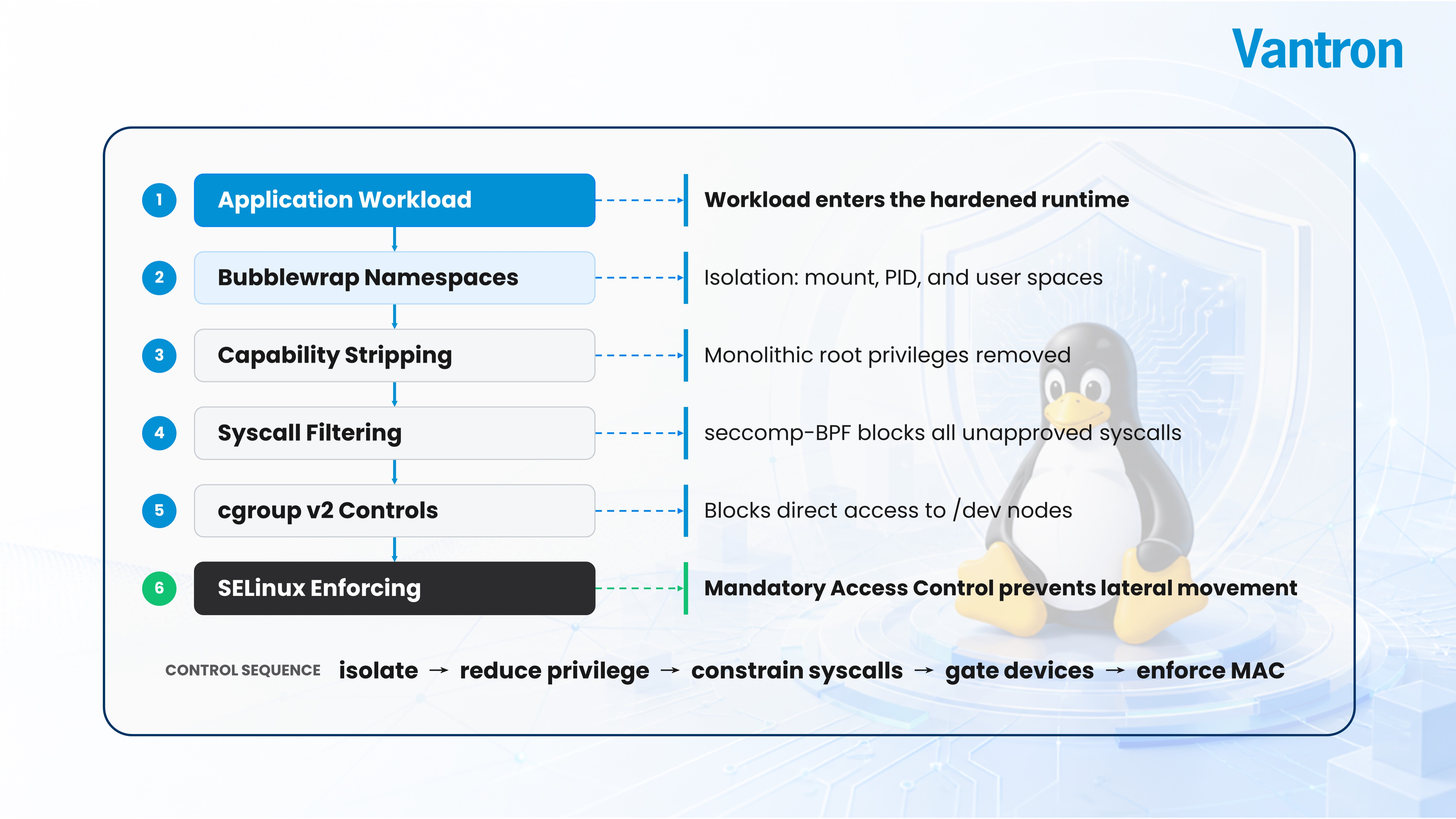
4. Orthogonal Data Protection
Confidentiality and integrity are treated as distinct guarantees:
• LUKS2 Disk Encryption: Data is encrypted via AES-256-XTS. Storage keys are sealed inside a TPM 2.0 module and released only if boot integrity measurements match. Detaching the drive yields only ciphertext.
• OS Immutability (dm-verity): The system partition relies on a Merkle tree root hash verified at boot. Offline alterations or corrupted blocks are blocked instantly at the kernel level.
• File Appraisal (IMA/EVM): Writable assets are verified before execution, protecting binary code and SELinux labels from unauthorized changes.
5. Cloud-Edge Cryptography & Resilient OTA
Private keys are the lifeblood of security, which is why signing keys never reside on the edge device.
• CloudHSM Signing: All firmware, kernels, and update payloads are signed inside a FIPS-validated CloudHSM. CI/CD pipelines never access private keys.
• Failure-Proof A/B Updates: Over-The-Air (OTA) updates write to an inactive partition. Following a signature check and trial boot, the boot sequence evaluates system health and automatically rolls back if conditions fail.
Built for Tomorrow’s Regulatory Standards
Vantron’s Linux security framework can support customers’ compliance and certification efforts by aligning relevant technical and lifecycle controls with the EU Cyber Resilience Act (CRA), IEC 62443 4 1/4 2, NIST SSDF, and SLSA guidelines.
The intended security outcomes are clear:
• Disrupted Cloud? The device operates safely offline.
• Stolen Hardware? The drive remains unreadable.
• Exploited Process? It stays trapped in its sandbox.
Security is not an add-on applied after the product has been designed. It is an architectural discipline that connects silicon, firmware, system software, applications, data, cloud services, manufacturing, and lifecycle maintenance. Through this layered approach, Vantron helps customers build industrial edge systems that are more resilient, manageable, and prepared for evolving cybersecurity requirements.
Talk with our engineering team to assess your Linux security requirements and identify the right protection strategy for your next edge product.

Vantron’s one-stop service addresses all complex requests.


